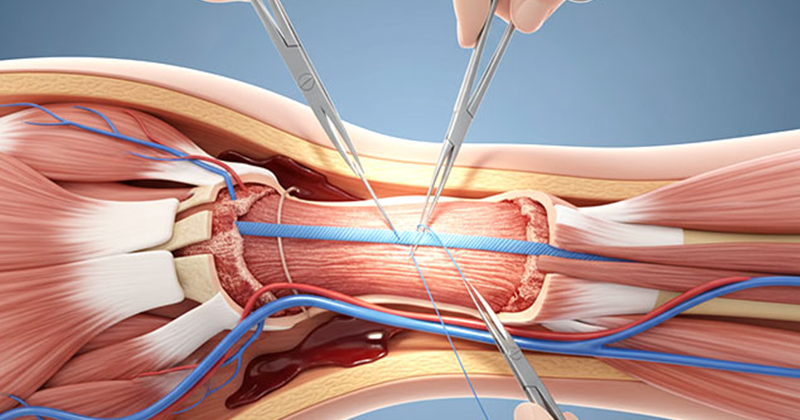
Tendon repair
Tendon repair is a surgical procedure performed to restore the continuity and function of a torn or ruptured tendon. Tendons are strong, fibrous tissues that connect muscles to bones and play a vital role in enabling movement and joint stability. Tendon injuries commonly occur due to trauma, sports activities, overuse, or degenerative changes associated with aging. Commonly repaired tendons include the Achilles tendon, rotator cuff tendons of the shoulder, flexor and extensor tendons of the hand, and patellar or quadriceps tendons around the knee.
The primary goal of tendon repair surgery is to reattach the torn ends of the tendon and restore normal movement and strength. The procedure is usually performed under regional or general anesthesia, depending on the tendon involved. During surgery, the damaged tendon ends are carefully identified, cleaned, and sutured together using strong, specialized stitches. In some cases, anchors, grafts, or augmentation techniques may be used to reinforce the repair, especially in chronic or severe injuries. Minimally invasive or arthroscopic techniques may also be employed to reduce tissue damage and improve recovery.
Postoperative care and rehabilitation are critical for a successful outcome. Initially, the repaired tendon is protected with splints, casts, or braces to allow proper healing. Gradual physiotherapy is then introduced to restore range of motion, strength, and flexibility while minimizing the risk of re-injury. The duration of recovery varies depending on the tendon repaired and the severity of the injury, but full functional recovery may take several weeks to months.
Advancements in surgical techniques, suture materials, and rehabilitation protocols have significantly improved the outcomes of tendon repair surgeries. Although potential complications such as infection, stiffness, or re-rupture exist, they are relatively uncommon with proper surgical care and adherence to rehabilitation. Overall, tendon repair is an effective treatment that restores function, reduces pain, and enables patients to return to daily and athletic activities.